
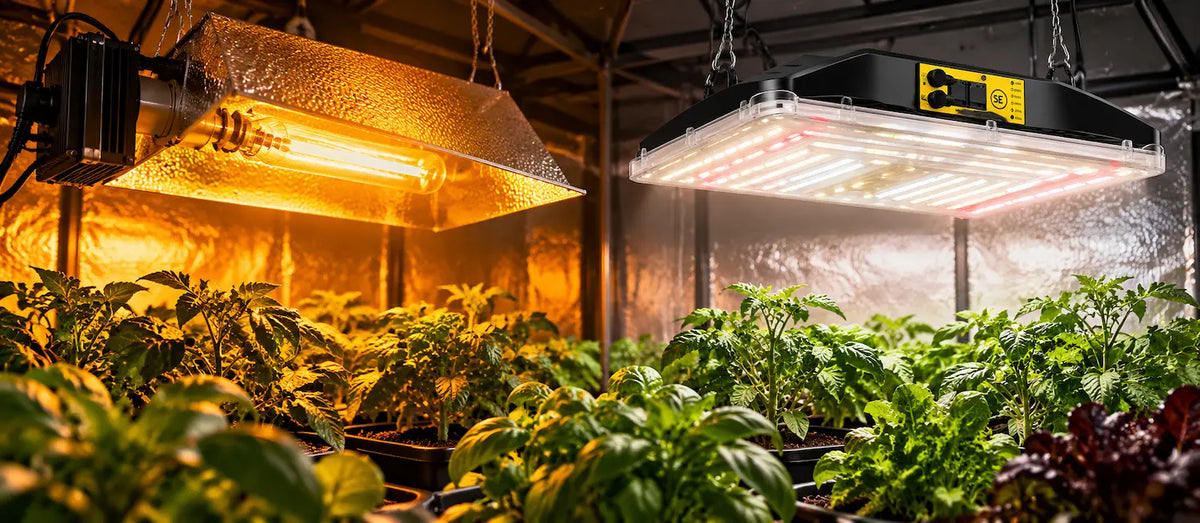
LED Grow Light vs. HPS Grow Light - Which Performs Better?
In general, LED grow lights perform better in terms of yield per watt compared to HPS grow lights . The difference in yield between LED and HPS lights at the same wattage is determined by several factors, such as efficiency, spectrum, heat production, and light distribution. Below is an overview of the most important differences:
1. Light Efficiency
LED Grow Lights
Efficiency : 2.0 - 3.0 µmol/J (some models up to 3.5 µmol/J)
Higher efficiency means more light output per watt of electricity, resulting in more usable light for plants, which means higher yields per watt.
HPS Grow Lights
Efficiency : 1.2 - 1.9 µmol/J
Lower efficiency means less light output per watt of electricity, resulting in a lower yield per watt compared to LED Grow Lights .
2. Light Spectrum
LED Grow Lights
LED grow lights can be specifically tuned to the photo-synthetically active radiation requirements of plants.
LED grow lights deliver a full spectrum or specifically tuned wavelengths of light (such as red and blue), resulting in improved growth and yield.
HPS Grow Lights
HPS grow lights have a spectrum that is heavily in the red, which is beneficial for flowering, but less effective for vegetative growth.
A limited spectrum can lead to less than optimal growth in the vegetative phase.
3. Heat production
LED lamps
LED grow lights produce less heat, which leads to a lower risk of heat-related problems and a more controlled growth micro climate.Less heat means that LED grow lights can be placed closer to the plants without burning the leaves/plants, increasing light intensity and therefore yield.
HPS Grow Lights
- HPS grow lights produce a lot of heat, which can lead to heat-related stress in the crop, meaning there is a need for additional cooling and ventilation.
- The plants must be held further away from the lamp, which reduces the effective light intensity.
4. Lifespan and Light Consumption
LED lamps
- LED grow lights have a longer lifespan (50,000 - 100,000 hours) with less decrease in light intensity over time.
- Stable light output means more consistent yields over the life of the LED Grow Light .
HPS lamps
- HPS grow lights have a shorter lifespan (10,000 - 24,000 hours) and experience a significant decrease in light intensity over time.
- Reduced light output can lead to declining yields as the lamp ages.
5. Output per Watt
Examples and Estimates
Below we present some practical examples. Please note: These are estimates, and your results may vary, as all circumstances play a crucial role in the process.
LED lamps
- Typically, LED grow lights can achieve a yield of 1.5 - 2.0 grams per watt under good conditions and grow management.
- Some high-end LED grow lights can even achieve 2.0 - 2.5 grams per watt, depending on growing conditions and the grower's experience.
HPS lamps
- Typically, HPS grow lights can achieve a yield of 0.5 – 1.0 grams per watt.
- Under ideal conditions and with top management practices, this can amount to up to 1.5 grams per watt, but this is still significantly less than what LED Grow Lights achieve.
Practical comparison at 600 Watts
- LED Grow Light
Expected yield between 900 grams and 1.5 kg. - HPS Grow Light
Expected yield between 300 grams and 900 grams.
Considerations for the right choice
- Investment costs
LED grow lights are often more expensive to purchase than HPS lights, but the investment pays for itself through lower energy costs and higher yields over the lifespan. - Cooling costs
LED grow lights reduce the need for additional cooling, which can save energy costs and provide a more stable growing environment. - Energy efficiency
LED grow lights offer higher energy efficiency, resulting in lower energy costs for the same or higher yield. - Spectrum Flexibility
LED grow lights can be adjusted to better support the plant's needs at different stages of growth than HPS grow lights .
Conclusion
LED grow lights generally offer a higher output per watt of electricity than HPS lights. This is due to their higher efficiency, better spectrum optimization, lower heat production, and longer lifespan.
While the initial cost of LED lights may be higher, the benefits in terms of yield, energy efficiency, and lower operating costs may outweigh the cost in the long run.